
Leaders must set red lines for peace and prosperity in the Middle East
Ordinary civilians should be at the heart of the equation. The bomb that exploded in Beirut on October 19th did more than cause death, injury and destruction. It brought into focus the long-overdue need for ordinary people, here in Canada as well as in the Arab World, to set “red lines” for leaders locally, regionally […]
Ordinary civilians should be at the heart of the equation.
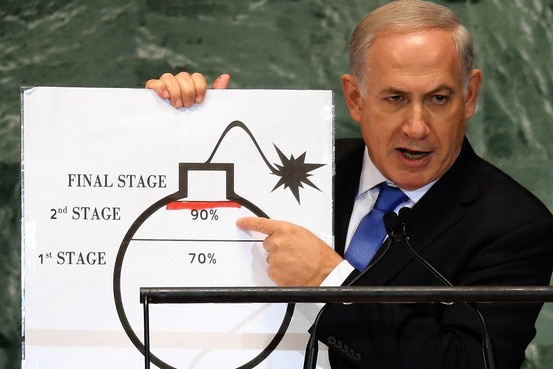
Israeli Prime Minister Benjamin Netanyahu literally drew a red line on a graphic of a bomb on Sept. 27, illustrating to the United Nations General Assembly in New York when he thinks the world will no longer be able to stop Iran from being able to build a nuclear weapon.
The bomb that exploded in Beirut on October 19th did more than cause death, injury and destruction. It brought into focus the long-overdue need for ordinary people, here in Canada as well as in the Arab World, to set “red lines” for leaders locally, regionally and internationally so that actions they take do not undermine the peace and prosperity of ordinary civilians in the Middle East.
Of course, we’ve recently seen leaders indulge in talk of red-lines. Unfortunately, these often threaten escalating conflict or favor the peace and prosperity of one group over that of another’s.
When we see Israel showing a “red line” at the U.N. about a potential future Iranian nuclear bomb, we should ask why Israel itself has (though it refuses to admit it) nuclear bombs and is unwilling to commit to a nuclear-free zone in the Middle East. This would surely enhance the odds for peace and prosperity of the region more reliably than trying to impose a dangerous, ineffective and costly war.
Speaking of “red lines,” we should also enquire as to why Israel crossed its own “red line” in a just-released secret Israeli government study from 2008 entitled “Food Consumption in the Gaza Strip – The Red Lines,” which showed that 106 trucks per day were needed to deliver the calories needed by Palestinians in Gaza under Israeli military blockade. In practice, only 67 trucks were allowed in by Israel.
While food restrictions were eased recently, the Israeli blockade remains a red-line issue that continues to be raised by ordinary people worldwide due to its crippling of Gaza’s economy, particularly its exports.
On Saturday, former Canadian MP Jim Manly, along with European lawmakers and activists, attempted to sail to Gaza in protest but were prevented by the Israeli Navy from reaching Gaza. As of October 23rd, they were detained by Israel.
In the case of Syria, sacrificing the well-being and rights of the Syrian people for geo-political gain is a red line that has been crossed by several players, many times over.
Regional and global leaders say they want to help the Syrians, yet we have to ask how continuing to supply military and logistical support that fuels a disastrous civil war can be a good solution when over 30,000 have died, hundreds of thousands have become refugees, the social and economic fabric has been shredded and priceless heritage sites have been destroyed.
An attempt at a temporary holiday ceasefire currently being proposed by UN envoy Lakhdar Brahimi has been welcomed by most players including Syria, Iran, the U.S. and Turkey. Perhaps this reflects pressure building on leaders to take immediate action to bring Syrians out of the abyss of misery and danger they have been plunged into.
Here in the Canada, when we see leaders mouthing the words “democracy, freedom, human rights, the rule of law” we need to ask them a very simple “red-line” question: “Do you believe all the peoples of the Middle East and the Arab World should have these equally? And do you believe all the governments in the region should be equally held to account to these values?”
If the answer is no, then a red line has been crossed to the detriment of ordinary people there. Moreover, a red-line has been crossed with Canada’s reputation when elected leaders profess support for these values and principles but actually undermine them in practice.
Canada’s bashing of the UN, severing of diplomatic ties with an important regional player and merging diplomatic missions with Britain (which has a resented colonial past in the Middle East) reflects a red-line level of rejection of dialogue, relations-building, diplomacy and multilateralism that can propel progress in peace and prosperity for the people of the Middle East and their neighbors.
Listening to Al Jazeera English interview politicians and pundits just after the Beirut bombing, I was struck by the focus on who might be responsible or could benefit politically. Largely missing was a focus on the disastrous impact on the peace and prosperity of ordinary Lebanese people, who now face the specter of another civil war.
It may seem like “motherhood and apple pie” to set red lines to ensure that the impact on the peace and prosperity of ordinary people in the Middle East is a central consideration for leaders locally, regionally and globally. Perhaps that’s because, peace and prosperity can enable the enjoyment of “motherhood and apple pie” – as much for ordinary people in the Middle East, as here in Canada.
Opinion piece by NCCAR board member Rula Odeh which appeared Oct. 24, 2012 in Embassy. The views expressed are her own.
About the Author
Rula Odeh

Rula Odeh is past president of the National Council on Canada-Arab Relations (NCCAR) and a current board member. She leads NCCAR’s media work including its flagship Daily Media Scan.
Posted on October 24, 2012