
One step forward, two steps back: Assessing Obama’s Jerusalem speech
Obama kept alive the hope for a two-state solution. At the same time, he narrowed the issue to focus only on the West Bank, and he even gave in on a basic tenet of US democracy.
A week before United States President Barack Obama went to Israel, The Economist had a suggestion about what he should say. Entitled “Spell it out, Barack,” a lead editorial argued that “As more people bemoan the death of a two-state solution, Barack Obama must strive to keep it alive.”
He seems to have listened, and selling hope is something Mr. Obama is rather good at.
One step forward
His speech to “The People of Israel” at the Jerusalem International Convention Center aimed to give hope to both Palestinians and Israelis. After a long introductory section praising Israel and professing deep friendship, Mr. Obama turned to the Palestinian issue using words that, as far as anybody can remember, have never been used by a serving US president.
He said the words “independent Palestine” twice. He called the Israel Defense Forces a “foreign army.” He condemned settler violence against Palestinians. He even used the word “occupation.”
“Neither occupation nor expulsion is the answer,” he said to a round of applause. He invited Israelis to put themselves in the shoes of the Palestinians.
“No American president or Israeli statesman has ever delivered a speech like this,” noted Gideon Levy, a well-known and well-respected columnist for the Tel Aviv daily Haaretz. “It deserves to enter the history books—and Israel’s textbooks.”
Mr. Obama’s criticism was directly aimed at politicians like Avigdor Lieberman who openly talk about expelling Palestinian citizens from Israel. Mr. Obama was also talking to those Israeli politicians who want Israel to completely take over the West Bank.
This part of Mr. Obama’s speech inspired hope because it humanized the Palestinians, sympathized with them and invited Israelis to do the same.
But two steps back
While inspiring hope, however, his presentation also marked a significant policy retreat.
In Cairo in 2009, for example, Mr. Obama was quite clear on the issue of the settlements. “The United States does not accept the legitimacy of continued Israeli settlements. This construction violates previous agreements and undermines efforts to achieve peace. It is time for these settlements to stop,” said Mr. Obama in Cairo.
Four years later, in Jerusalem, his only references to the settlements was to say they were “unhelpful” to peace and that he wishes the violent settlers who attack Palestinians be brought to judgment.
Back in Cairo, Mr. Obama also recognized that many Palestinians are still in refugee camps on Israel’s borders. “For more than 60 years they [the Palestinians] have endured the pain of dislocation. Many wait in refugee camps in the West Bank, Gaza, and neighbouring lands for a life of peace and security that they have never been able to lead,” he said.
In his Jerusalem speech, however, the refugees were not even mentioned. It is as if the 4.7 million Palestinian refugees no longer existed, or were even worth mentioning.
Mr. Obama’s two-state solution for peace seems to only focus on the West Bank, where about a quarter of the total Palestinian population lives.
The second step backward is worse
Having apparently narrowed the Palestinian question to the West Bank, Mr. Obama then introduced something completely new into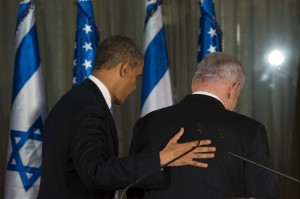 official US discourse. “Palestinians must recognize that Israel will be a Jewish state,” he demanded.
This is both new and significant. In Cairo he had simply repeated the American position that Israel should be recognized as a state. (Israel’s peace treaty with Egypt, for example, recognizes the state of Israel. It says nothing about Israel as a “Jewish state.”)
To those who have not visited Israel, the real meaning of “Israel as a Jewish state” might not be immediately obvious. Of course Israel is, in every possible way, a “Jewish country.” Eighty per cent of its citizens are Jewish. Its flag is the Star of David, its weekend is Friday and Saturday, its national holidays are the Jewish holidays, there is a mezuzah on every doorway, and so on. Nobody could mistake it for anything else.
In a similar vein, (though with rather less fervour) it is also fair to say that Canada is a Christian country. (77 per cent of Canadians say they are Christian, we generally follow Christian traditions and holidays, and even our swear words often have a Christian origin.)
But while Canada is a Christian country, it is a secular state. That is to say, we are all equal before the law. All Canadians, whether Christian, Jewish, Muslim, atheist, or otherwise, are all legally equal.
Israel, on the other hand, describes itself as a “Jewish state.” Dozens of laws explicitly favour Jews and therefore discriminate against about the 20 per cent of its population that is non-Jewish (mainly Muslim and Christian citizens of Palestinian origin).
Of course, there is discrimination and racism in every country in the world, including Canada and Israel. But in a secular, democratic state like Canada, discrimination on racial or religious grounds is against the law.
Paradoxically, Israeli law does say that everyone is equal. But it also says that Israel is a Jewish state. Where these two notions are in contradiction, the Jewishness almost always trumps the democracy. As a result, in the Jewish state of Israel, the courts have found that it is legal to favour Jews in housing, education, employment, land ownership, and family reunification amongst other areas. In fact, the last Knesset (Israeli parliament) passed several more laws that specifically favour Jews—even those secular Jews who are not religious at all.
In demanding that Palestinians recognize Israel as a Jewish state, Mr. Obama apparently wants them to accept these flagrant violations of basic democracy. Ironically, Israel continues to call itself the “only democracy in the Middle East,” even as its new laws make it increasingly similar to other undemocratic states in the region.
Summary
Mr. Obama seems to have followed The Economist’s suggestion—to keep alive the hope for a two-state solution. To do that, he had to show the Palestinians that he “understood” their pain, while at the same time telling Israelis that the US would back them no matter what. He appears to have been brilliantly successful.
At the same time, however, he backtracked significantly on earlier positions. He narrowed the issue to mean only the West Bank, apparently giving up any hope for justice for the 4.7 million Palestinian refugees. And he even gave in on a basic tenet of US democracy—namely that all citizens are equal—by endorsing an undemocratic Jewish state, which legally discriminates against 20 per cent of its own population.
I call that one step forward, two steps back.
Opinion piece by NCCAR Vice-President Peter Larson, originally published in Embassy Magazine, March 27th, 2013.
About the Author
Peter Larson

Peter Larson is chair of the National Education Committee on Israel/Palestine with the National Council on Canada Arab Relations.
Posted on March 28, 2013