
My 2010 Summer Parliamentary Internship Report: Office of Liberal MP Gerard Kennedy

By Jana Chehayeb
Arriving at the Confederation Building on the west side of Parliament at 9:30 am on July 6, 2010, I had no idea what to expect. What I did not know was that my internship was to last for 6 weeks but leave a mark on me for a much, much longer time. One would think that with Parliament having risen for summer recess, boredom would hit and there would be little to do; however, my experience was very much the contrary as there were constantly tasks to be completed to contribute and occupy my time.
Each day I woke up, got ready, and power walked/jogged from the University of Ottawa where I resided to the office by 9 am. It was usually warm, and the scenery I had the privilege of seeing every day never got old. I would cross the Rideau Canal and walk the crowded streets between the high rises downtown. Once I got to the office, I would skim through and compile several of the 20-30 news clips we received each morning relevant to the Liberals and/or Gerard Kennedy, the Member of Parliament for whom I worked. I was most often assigned to weed out clips related to the Canadian census, a major hot topic in the news the entire time I worked at Parliament. After that, my supervisor would usually give me some sort of research or administrative assignment to work on.

Assignments and work
One assignment I found particularly interesting was researching homelessness statistics in various Canadian cities. My supervisor basically offered me and my co-intern the option to choose any topic of relevance to Mr. Kennedy that we were personally interested in learning about. So I chose homelessness. What I learned from researching cities like Calgary, Edmonton, Toronto, Winnipeg, among others is that homelessness is overall on the rise, and meanwhile things are being done about it at the provincial, municipal and non-profit organizational level, the Federal Government—opposite of what it promised just a few years back—has yet to properly address and provide sufficient resources to aid in this very significant issue that affects over 350,000 people in this country. In fact, I was truly amazed to discover how many people are at risk of or are currently experiencing some level of homelessness, whether it be absolute (i.e. when a person lives on the streets) or sheltered (i.e. when a person has a shelter of some sort to stay in) homelessness, short or long term.
We often do not realize how many people on a given night will be sleeping in their cars, in the bushes near our homes, or “couch surfing” at a friend’s place. We tend to disregard this issue, as the Federal Government has done by failing to create a national housing strategy. In fact, in the last 10 years, the Federal Government has not been funding housing, and so it is very important that it does “come to the table” to face this problem as Mr. Kennedy stated recently in The Daily Press. One thing many concerned with this issue are rooting for is an organized national homelessness count throughout Canadian cities that keeps annual or biannual homelessness count statistics to help track our country’s progress in eliminating homelessness. I completely support such a strategy as I saw for myself, in gathering data, the lack of standardized measures of homelessness that exist across the various Canadian cities. I believe that the first step in addressing this issue is organizing the way we choose to measure the extent to which homelessness affects the lives of individuals and families living in Canada.
Mr. Gerard Kennedy
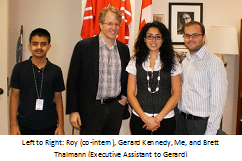 Next, I would like to talk a bit about Mr. Kennedy and discuss some other topics relevant to him that I was somehow involved in during my internship. Although I only had the pleasure of seeing Mr. Kennedy for less than 2 days, the impression I got from him instantly is that he is very personable and truly comes off as the humanitarian he is portrayed as in the media. “Call me Gerard.” That was one of the first things he said to me as I initially approached him nervously calling him “Mr. Kennedy”. Gerard entered the federal political leadership scene in 2006 and, during the October 2008 elections, became Member of Parliament for the Parkdale-High Park riding. He currently serves as the Critic for Infrastructure, Cities and Communities with responsibility for housing.
Gerard’s involvement years ago with food banks at the local and international level is one thing that I find particularly interesting because I was also involved in food bank-related volunteering on a much smaller scale years back and believe that funding for this cause is so crucial. In the late 1980s, Mr. Kennedy was recruited from his role as first executive director of Canada’s first food bank in Edmonton in order to fulfill a similar position for Toronto’s Daily Bread Food Bank, where he worked until 1996. Without even a penny of government money, Gerard became responsible for handing out $30 million worth of food each year, which reached over 150,000 people on a monthly basis! He was also the national spokesperson for food banks and helped local initiatives develop food banks and methods to solve poverty in Canada as well as in various countries abroad. Fast forward years later…now, still as much the humanitarian, Gerard is highly concerned with meeting the needs of people throughout as well as outside of Canada.
In fact, the first federal bill ever introduced by Gerard is one concerning people abroad. Specifically, the war resisters bill (Bill C-440) that he brought forward in September 2009 serves to grant U.S. soldiers fighting in Iraq the opportunity to come reside in Canada in resistance of the war seeing as they have experienced penalizations when they tried to go back to the United States. I support Gerard’s belief that these soldiers have the right to choose to escape a war they feel is immoral. I feel that they would not choose to resist it if it was not truly an inhumane and unjust war to be involved in. Debate on second reading for the bill will commence later this month of September 2010.
Another important issue that caused a stir in the office while I was there was the issue of the Federal Government’s unrealistic project completion deadlines of March 31, 2011. Basically, the Government has allocated funds to various cities to be used for infrastructure projects, yet plans to cut off the funding after that March date; this will result in several incomplete projects whose wrapping up will become the responsibility of taxpayers. This is unfair. In fact, a Toronto Star August 11, 2010 report stated that Parliamentary Budget Officer Kevin Page cautions that up to $500 million could go unspent, out of $4 billion budgeted for the infrastructure program. I support Gerard’s opinion that the Conservatives need to extend the deadline date so that municipalities are not left hanging.
In terms of my involvement with the above issues among others, part of what I did was to organize, count, file, and database post cards, phone calls and emails from different concerned citizens who wanted to get in touch with Gerard to discuss and deal with these issues brought forward. I also did a fair deal of background research on certain experts in the fields of affordable housing, transit and infrastructure who had contacted Gerard to bring their thoughts forward on these topics. In doing so, I learned what types of issues were of major concern to a large number of people and what Canadians felt was not being dealt with properly by our current Federal Government body.
 One of the biggest issues of concern right now, as I mentioned previously, is the issues of the Canadian Census. The Federal Government has decided to cut out the long form census and maintain the short form mandatory census. This created a heightened level of controversy from various parties such as medical associations, homelessness committees, universities and colleges, among many, many others who have previously relied on the long form census to gather and update record statistics for their organizations. I was very disappointed in this move by the Federal Government and feel it is necessary to undo the damage the government has done. The long form should be brought back.
Michael Ignatieff

On another note, while I was in Ottawa, I had the opportunity to attend my first rally which just so happened to be the kick-start rally for the Liberal Express summer tours. I watched Liberal Leader Michael Ignatieff address the concerns of people of various cultures, ages, and backgrounds living in Canada. Some of the concerns he addressed are jobs, healthcare, pensions, and post-secondary education. He pointed out the $1 billion dollar that the Federal Government wasted on poor planning and unnecessary costs (i.e. the fake lake and five-star gazebos) for the G20 Summit, as well as Stephen Harper’s unexpected and unwelcome recent parliamentary prorogations. Mr. Ignatieff spoke of a “Clear Liberal Alternative” to the current government. One that would avoid wasting taxpayer dollars; one that would listen to its people and address the issues they were most concerned with. It was interesting for me to be directly involved in this political competition and to see the positions that the MPs who acted as critics of Conservative MPs took on various issues. Interestingly enough, while I was in Ottawa, the votes for the Conservatives reached a markedly low number, meaning that Canadians truly feel a level of dissatisfaction with the Federal Government. Hence, it is important that many of the issues Mr. Ignatieff spoke to during his Liberal Express tour are brought to the forefront if the current government is to secure its place as the leading party.
In conclusion, I would like to say that this parliamentary internship is one I will never forget. It helped me explore the world of Canadian politics, brought me to a new city where I met many incredible people and built lasting friendships, and opened up new doors into my future. I highly recommend anyone interested to apply for this internship. Thank you, NCCAR, for the great opportunity!
~~~ ~~~
~~~
Posted on December 10, 2010